Where We Started: The Story Behind Joy Meadows' Family Resource Center
It started with the idea that maybe if caregivers in foster care weren't alone in going through hard things, they could better help the children who were going through the hardest things through no choice of their own. It was the shared reality that isolation brings hopelessness — the overwhelming experience that brokenness is rarely one moment, but layers of complexities that bring layers of need. Every family experiences hard things, and without a support system, that turns into the slippery slope of crisis. At its core, Joy Meadows began from the deep desire to be seen, known, and connected to walk through hard circumstances.
The Crisis That Started It All
At the end of 2017, the foster care crisis in Kansas was at its peak. Foster home recruitment continued, but burnout outpaced it, leaving a constant deficit. Children were sleeping in offices. In response, the "one night kids" emerged — children dropped off at 11pm, picked up at 6am, because staying under 24 hours allowed placements beyond capacity limits.
With a backpack of clothes and a ziplock bag of meds for depression, anxiety, and ADHD, the kids would come and go to a different home every day. They didn't go to school. Siblings were split up. Many were placed hours from home. Stability was rare, and educational and mental health needs went unmet. Case managers were overwhelmed. Foster parents were in crisis. There was little capacity left to support biological families working toward reunification. Systems couldn't function at their best — they were simply trying to respond to crisis. And in the middle of it all were the children, experiencing foster care itself as another layer of trauma.
Building Something Different
Out of that loneliness, desperation, and overwhelm, Joy Meadows began. Foster parents recognized that together they could support one another, and do better for the children. They had to do better for the children. By the end of 2017, paperwork was filed to become a 501(c)(3). Fundraising followed in 2018–2019, and property was purchased at the end of 2019.
There was not a formal logic model, theory of change, or evidence-based structure. It was just a deep awareness that something different had to be done — a knowing that community changes things, that relationships are healing, that joy is essential, and that it takes everyone.
The concept of Joy Meadows was to create a community where foster families could encourage each other and keep going. That led to informal community gatherings like "Second Saturday" out on the property. Churches were invited to wrap around families through "care communities" to help prevent burnout. Immediate needs, like clothing for emergency placements, led to a clothing closet. Volunteers were given meaningful ways to contribute beyond fostering themselves, stepping in to support exhausted families and use their unique skills. Recognizing that children with trauma often struggle in typical environments, summer day camps were created just for them. And the lack of trauma-informed therapists led to bringing providers together in one place to better serve foster children. As needs arose, needs were met — working alongside child placing agencies, other nonprofits, churches, and caregivers.
A Hub Takes Shape
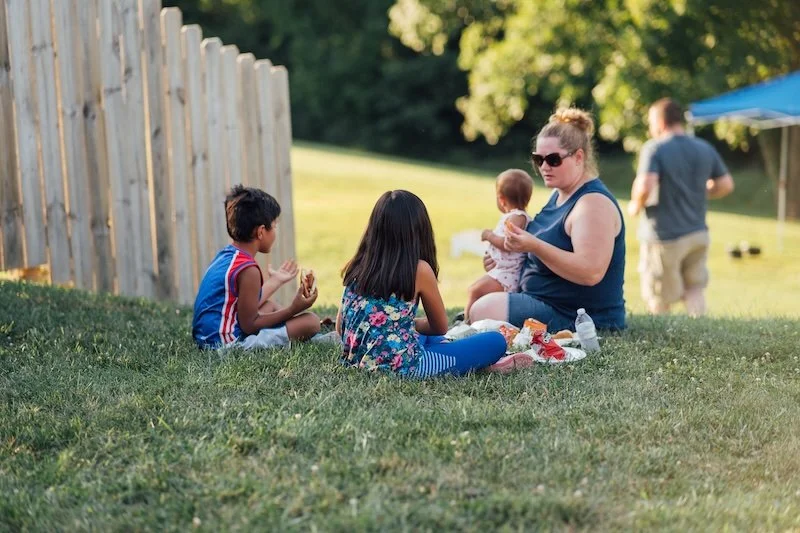
What emerged was a hub — a centralized place meeting the needs of children and families through community, nature, animals, and relationships. A place that acknowledges layered needs with layered support. A place with real people. A place for "I see you" moments.
At the time Joy Meadows began, there was limited research to describe this kind of model. But across the country, similar community-based responses were emerging from the same shared experiences of crisis that families were facing. While not all were specific to foster care, they were all recognizing that child welfare programs were primarily dealing with a symptomatic response and could not provide long-term healing mechanisms for families. By 2026, the term "family resource centers" has become widely recognized.
What Research Confirmed
At the same time, research on childhood trauma was growing. What foster families experienced firsthand was now being supported by evidence. As Dr. Bruce Perry explains, because trauma happens in relationships, healing must also happen in relationships. In his book What Happened to You?, Perry describes how meaningful recovery requires repeated, safe, and positive relational experiences that rebuild trust, emotional regulation, and security. Healing cannot happen in isolation — it requires layered relationships within a community and a wide-ranging offering of services to meet families where they are.
Five Years of Growth
Over time, through relationships and a deep compassion for children in foster care and their caregivers, Joy Meadows has slowly — and imperfectly — grown into a strengths-based, family-centered model shaped by that understanding. In just five years since opening the 40-acre Linwood Campus, on-site support interactions grew from 320 in 2020 to 7,082 in 2025, reflecting both increasing need and expanded capacity.
Today, Joy Meadows serves families across Douglas, Leavenworth, Johnson, and Wyandotte counties, and beyond — through collaboration with nonprofits, agencies, churches, and volunteers. What began as a hope to address housing instability has grown into a place of stability and encouragement across many areas: over 2,300 therapy sessions, 450 equine sessions, 250 animal program engagements, 150 children served through summer camps, 1,200 individuals supported through the clothing closet, 7,000 pounds of food distributed through the garden and orchard, 2,000 attendees at "Second Saturday" gatherings, 100 mentor sessions, and ongoing church-based support for families statewide. With more than 6,000 volunteer hours, Joy Meadows has become a resource hub offering support, stability, healing, and joy.
What's Next
The mission of Joy Meadows, created in 2017, is to "provide families with community support, housing and resources so that children impacted by foster care can find stability, healing, and joy." Each aspect of that mission statement came from the lived experience that it takes all of those things — community support, housing, and resources — to support families and children well.
Family resource centers, also referred to as family success centers, family support centers, or parent-child resource centers, are recognized as community-based, welcoming hubs that provide free or low-cost help where families can access formal and informal supports to promote child and family well-being. They vary in format and location — from apartment complexes, schools, health centers, community spaces, and churches — and while their services vary, they all focus on things like parental resilience, social connections, concrete support, knowledge of parenting and child development, and the social and emotional competence of children.
The history of Joy Meadows reflects this hub approach, meeting families in their needs so that children impacted by foster care can find stability, healing, and joy. As we continue walking alongside foster families at the Linwood Campus, we are also looking ahead — growing a community-based, wraparound model of support for the entire family impacted by foster care, including biological parents, foster parents, and kinship caregivers — as we open a second campus in Kansas City, Kansas. Whether it's called a "family resource center" or simply known as a place where people can always come for help and healing, Joy Meadows will keep stepping into opportunities to support families so that children truly experience long-term stability, healing, and joy.
⁶ Perry, Bruce D., Winfrey, Oprah. (2021). What Happened to You? Conversations on Trauma, Resilience, and Healing. Flatiron Books. And Hambrick, Erin & Brawner, Thomas & Perry, Bruce. (2018). Examining Developmental Adversity and Connectedness in Child Welfare-Involved Children. Children Australia. 43. 105-115. 10.1017/cha.2018.21