What a Sweet Potato Taught Me About Trauma and Therapy
Therapy is essential. I know this.
Every child we’ve cared for over the last decade has participated in therapy as they navigate the deep wounds that come with foster care. Therapy is the path forward. It is the tool that helps bring buried pain into the light. It is the steady push when growth feels impossible. It offers support, clarity, and hope when everything feels blurred and overwhelming.
And yet—I hate it.
As a foster parent, taking a child to therapy often feels like poking the bear. There may be screaming on the way there. If not, there will almost certainly be screaming on the way out. That night comes the fallout: memories, triggers, nightmares, anger, everything that would feel easier if it could just remain hidden.
Therapy can also feel hopeless. Children are with us for only a season. There is no quick fix. No cure. No pill that can erase what they’ve endured. Sometimes I catch myself thinking it might be easier to simply endure the time until a court makes a final decision to send a child back into circumstances that will be still be hard and take them back to this trauma we are trying to heal. Just skip the therapy with all of its hard things. That might feel easier for our household, maybe even for the child.
But that isn’t true.
Recently, we walked this journey with several young sisters placed in our home. Every week required moving mountains: packing special snacks and water, preparing visual cues the night before and the morning of, paying a sitter to accompany us, rearranging schedules, coordinating with schools. And once we arrived, therapy brought exactly what we expected—escape attempts, screams, resistance, dissociation. Sometimes that looked like pretending to be a dog. Sometimes it meant curling into a fetal position. Working through memories of abuse was just too much. It was overwhelming for their little hearts and minds.
And then—unexpectedly—we found a solution.
It came in the form of a sweet potato.
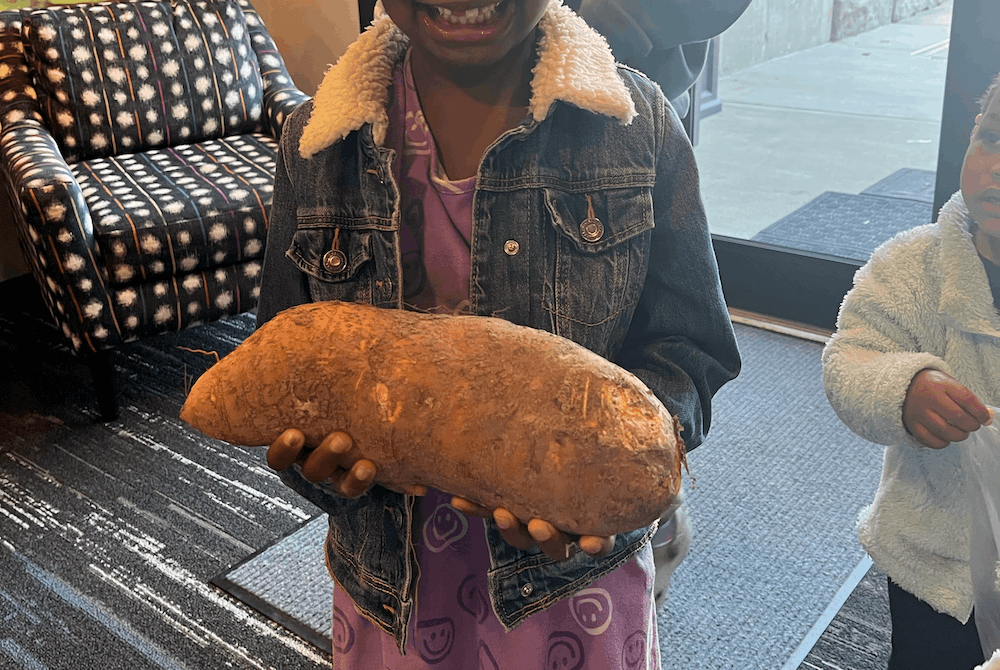
Sweet potato from the Joy Meadows garden used as a therapy transition tool.
The garden at Joy Meadows is open to anyone on the property. Volunteers plant, tend, and harvest the produce, which is then brought into the Therapy Center to share freely. One day, during an especially difficult session, one of the girls tried yet again to run—but she stopped abruptly when she passed the vegetables by the door.
She froze.
Her eyes widened as she picked up the largest sweet potato any of us had ever seen. She inhaled the earthy scent as flecks of dirt fell to the floor. She traced the rough skin with her fingers. She shifted its weight in her hands, adjusting to how heavy it was.
And just like that—she was grounded. Regulated. Fully present with us again.
That sweet potato became our transition plan.
Now, each girl chooses a vegetable from the Joy Meadows garden as part of their transition out of therapy—back into the world, back to the car. It has become their delight, their highlight, their joy.
That sweet potato reminded me that God gives us what we need.
Healing requires bringing hard things to the surface—not leaving them buried. It is my responsibility to do that work for the children entrusted to us, trusting that God will meet us there. The process may be messy and uncomfortable, but it is necessary.
“I waited patiently for the Lord to help me, and he turned to me and heard my cry. He lifted me out of the pit of despair; out of the mud and the mire. He set my feet on solid ground and steadied me as I walked along. He has given me a new song to sing, a hymn of praise to our God. Many will see what he has done and be amazed. They will put their trust in the Lord.” Psalms 40:1-3.